
Patterns From User Research
Same struggle, completely different root causes

I interviewed people with executive dysfunction during my validation research.
Before building Asaura AI, I thought I understood the problem. I’d researched productivity for years, but when I sat down for structured validation interviews, I realized I’d been making a dangerous assumption: that everyone gets stuck in the same way.
They don’t.
Meet Three People Who Struggle for Different Reasons
Person A: The Blank Canvas Problem
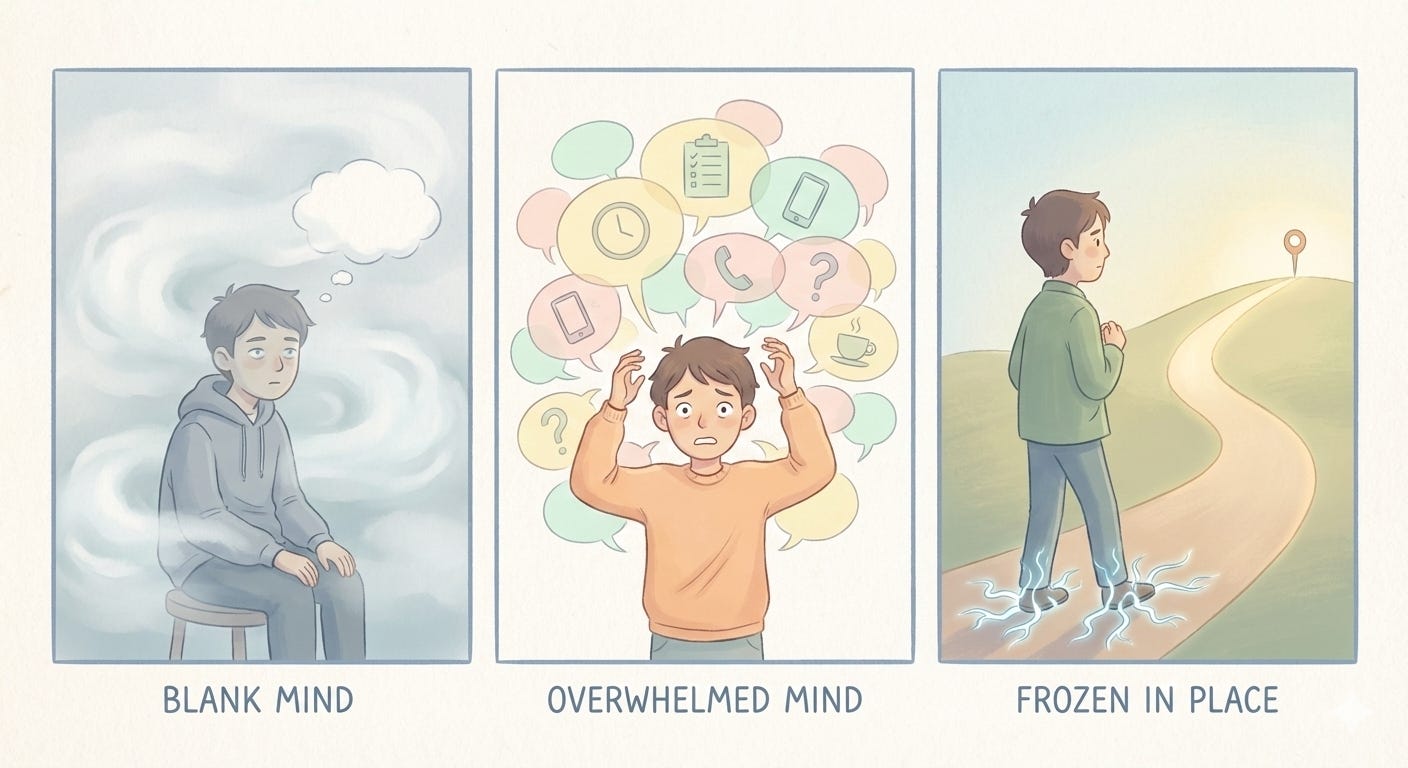
When she looks at a task like “organize finances,” she sees nothing. No steps. No entry point. Just a wall of fog. She described it as standing in front of a locked door with no handle. She knows there’s something on the other side, but she can’t figure out how to access it.
When I asked her to walk me through what happens in her head, she said: “I stare at the words and wait for something to appear. Like my brain is buffering. And then I feel stupid because I know other people can just... see what to do.”
Her barrier is cognitive: she can’t generate any action steps. Her executive functions aren’t retrieving the procedural knowledge she needs to begin.
Person B: Decision Paralysis From Too Many Options
He sees every step. All of them. At once. When he looks at “organize finances,” his brain generates fifteen possible entry points, each with its own branching pathways. Should he check his bank account first? Sort receipts? Update his budget? Pay bills? Every option branches into more decisions.
Every option feels equally urgent and equally overwhelming. He described it as “trying to walk through a doorway where twenty people are all trying to exit at the same time.” Everything gets jammed.
His barrier is cognitive overload: too much information, too many decisions, no clear hierarchy. His executive functions are working overtime and burning out before he can even choose a starting point.
Person C: Knowing Exactly What to Do but Unable to Start
Her case stands out because she has perfect clarity. She knows she needs to open her laptop, navigate to her banking portal, download last month’s statement, and review transactions. She can visualize each step. She can even articulate why it matters.
And yet, she can’t make herself begin.
She told me: “I’ll be sitting on the couch, fully dressed, fully awake, knowing I have 30 minutes before my next meeting, and I just... don’t move. I’m not distracted. I’m not doing something else. I’m just frozen.”
Her barrier is task initiation failure at its purest form: the neurological bridge between intention and action has collapsed. Her planning systems work fine. Her motor execution systems won’t engage.
What Everyone Agreed On
Despite their different experiences, they converged on one critical insight: the moment of “stuck” happens before the task itself.
One of them put it perfectly: “I don’t avoid doing things. I avoid the thinking part.”
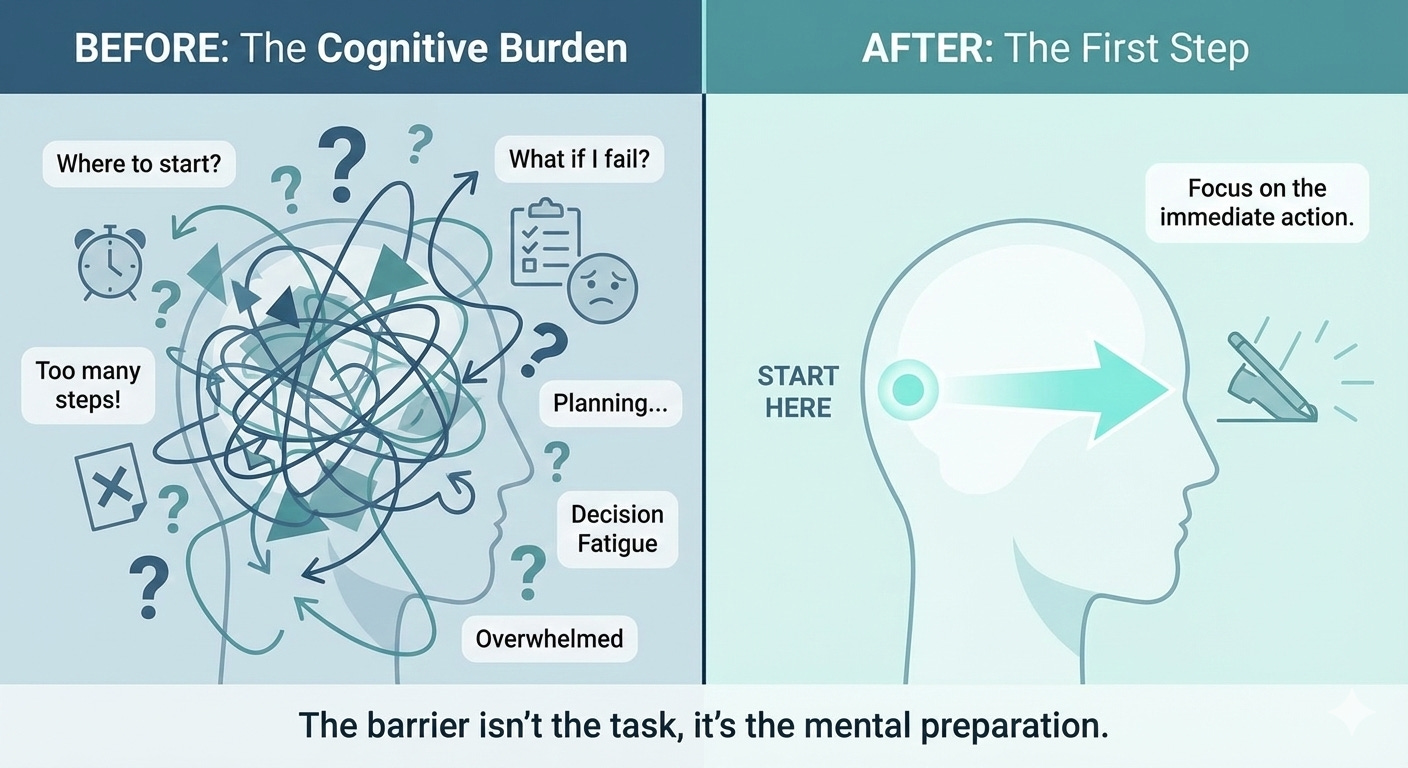
This was the breakthrough that reshaped how I’m building Asaura. The problem isn’t the task. The problem is the cognitive work that has to happen before action can begin: the planning, the decision-making, the mental load of figuring out how.
Traditional productivity tools assume you can do this part. They give you a blank to-do list and expect you to fill it with clear, actionable steps. They assume you can look at “organize finances” and mentally decompose it into “Step 1: Open laptop. Step 2: Log into bank. Step 3: Download statement.”
But for people with executive dysfunction, that decomposition process is where everything breaks down. Some people can’t generate the steps. Some people generate too many and short-circuit. Some people generate them fine, but can’t translate that plan into action.
How These Insights Shaped Product Decisions
This is why Asaura doesn’t ask you to create tasks. It doesn’t give you a blank canvas and expect you to fill it. Instead, it does the decomposition work for you.
You input a vague goal: “organize finances.”
Asaura returns: “Open your laptop and navigate to your bank’s website. 3 minutes.”
No planning required. No decisions to make. No fifteen branching pathways. Just one clear, concrete action that takes under five minutes.
For Person A, this removes the “blank canvas” problem. She gets a visible first step instead of cognitive fog.
For Person B, this removes decision paralysis. There’s no choosing between options because the tool has already chosen for her.
For Person C, this removes the cognitive load barrier. There’s no “thinking part” left to avoid.
What Comes Next
These interviews taught me something critical: if you’re building a tool for executive dysfunction, you can’t assume a one-size-fits-all solution, but you can identify the common thread and design for that.
This is Day 8 of 100 Days of Building in public. I’m sharing the entire journey of building Asaura AI: user research, product decisions, and the behavioral science behind it all. If this resonates, sign up for early access on our site or follow along here as I build.
Different manifestations. Same cognitive barrier. One approach that removes it.
Hodman Murad is a Data Scientist and founder of Asaura AI, an AI personal assistant designed for adults with executive dysfunction. She’s documenting his build process publicly through her 100 Days of Building series.
We spent 6 months building what we thought users needed before doing proper validation interviews, and it's wild how wrong our assumptions were. Great article!
Solid breakdown of the pre-task cognitive load problem. The part where someone said they avoid the thinking part not the doing really cuts through alot of the usual productivity advice. I deal with a mix of Person B and C depending on the day which is wh y generic todo lists never worked. Framing it as removing the decompostition work entirely feels like the right angle.